
Intellectual Property
Classes of Trademarks in Australia: Which Ones Do You Need?
The short answer
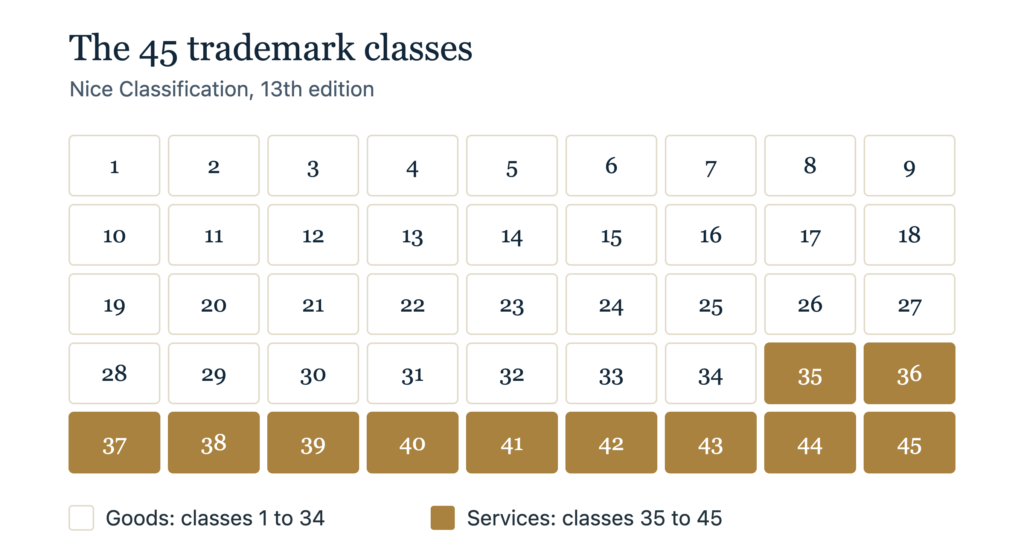
Australia uses the 45 trademark classes of the international Nice Classification. Classes 1 to 34 cover goods and classes 35 to 45 cover services.
Your registration only protects the goods and services you list, so the classes you need are the ones that match what you sell now, plus any genuine near-term plans.
What are trademark classes in Australia?
A trademark class is a category of goods or services that defines what a trademark protects. Because a trademark is registered only for the specific goods or services it covers, rather than for a name or logo in the abstract, the classes are the system used to sort and describe those goods and services.
Australia uses the Nice Classification, an international system currently in its 13th edition and shared by most trademark offices worldwide. It takes its name from the French city of Nice, where the agreement that established it was signed in 1957. The system divides all goods and services into 45 classes, with classes 1 to 34 covering goods and classes 35 to 45 covering services. Because the same system is used internationally, classifying your trademark correctly in Australia also supports any later overseas filing through the Madrid system.
A class heading is a guide rather than a grant, so registering in class 25 does not protect everything that class 25 contains. Your protection is defined by the specific goods and services you list within the class, which is called the specification.
How to choose the right trademark class
To choose the right trademark class, match each thing your business actually does to the class that covers it, working activity by activity rather than by the industry you belong to. Most businesses need more than one class, because they both sell goods and provide services, and each side has to be covered separately.
The four steps below work through that process.
1Split goods from services
›
List what you sell as physical products, which are goods in classes 1 to 34, separately from what you do for customers, which are services in classes 35 to 45. A business that makes a product and also provides a service usually needs a class on each side, so a gym that sells branded clothing needs class 41 for its training services and class 25 for the clothing.
2Cover core activities, not incidental ones
›
Register the goods and services that are central to the brand, because classes you do not actually trade in add cost and create the exposure covered in section 6.
3Check for offerings that span classes
›
A single product line can require several classes, so a subscription box needs class 35 for the retail service plus the goods classes for its contents, and software is often class 9 for a downloadable app and class 42 for a hosted platform.
4Include genuine near-term plans
›
Because you cannot add classes after registration, cover the products and services you genuinely plan to launch soon, but avoid claiming classes for vague possibilities.
Worked exampleHow many trademark classes does a business need?
›
A business needs one class for each distinct activity it wants to protect, so the number is the output of mapping its activities, not a figure chosen in advance. Take a clinic that treats only children. Its activities map to classes like this:
- The clinical care it provides sits in class 44.
- If it runs parent workshops or training, that is class 41.
- If it manages or franchises clinics for other operators, that is class 35.
- If it sells its own branded products, such as supplements or skincare, that is the relevant goods class, for example class 5.
A clinic that only treats children and does nothing else needs one class, which is class 44. Each further activity it takes on adds its own class.
As a final check, work through the activities you would want to stop a competitor from copying and confirm that each one falls within a class you have registered, because any activity left outside your classes is one you cannot enforce against.
Common pitfallWhy does one picklist search return several classes?
›
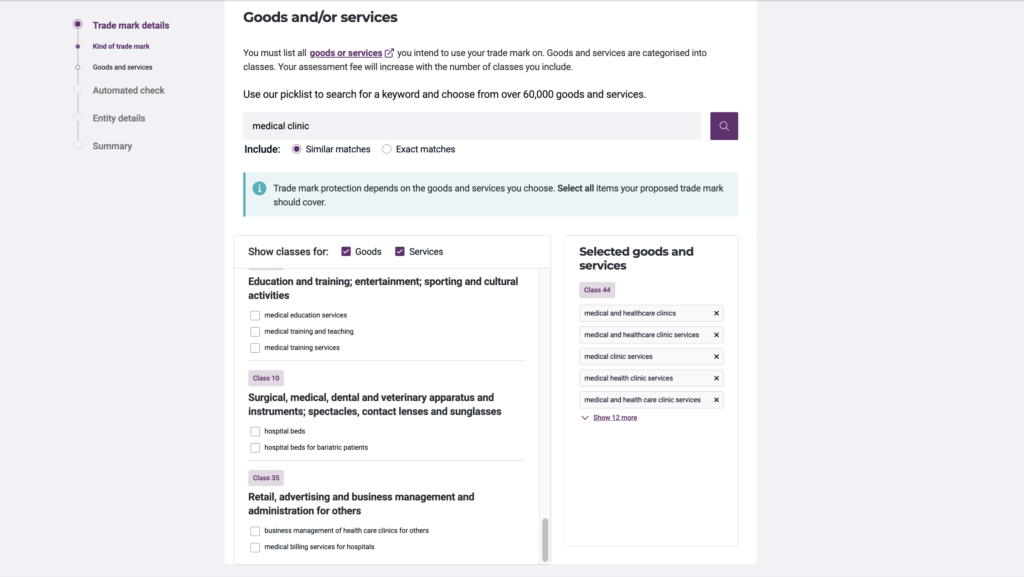
When you type a plain-English term into IP Australia's picklist, it does not return a single class. Searching "medical centre" surfaces suggestions across class 43 for elder care and day-care centres, class 42 for medical research, class 10 for hospital beds and treatment chairs, class 12 for hospital carts and class 41 for medical training, alongside the class 44 you were expecting. The tool is showing you everything that mentions your keyword, not telling you what your business needs.
This is where self-filing goes wrong, because the list mixes classes that are genuinely yours with classes that are simply noise. For a clinic that only treats children, class 41 belongs on the list only if it actually runs training or workshops, class 42 medical research is almost certainly not its business, and class 10 hospital beds is a goods class it would never touch. Work back to your activity map and keep only the classes that match something the business really does, then move on to choosing the descriptions within each.
Common trademark class mistakes to avoid
The most common classification mistake is choosing a class by industry label instead of by what the business actually does. The four below cause most of the gaps we see, and each leaves part of a brand unprotected.
Which class do cosmetics go in?
Do I need class 35 to sell my own products online?
Which class is beer in?
Do I need a goods class and a services class?
Will a different class clear an existing mark?
A common but mistaken assumption is that filing in a different class keeps you clear of an existing mark. Under IP Australia's examination practice, the class number is not what decides whether two marks conflict, and closely related goods or services can clash even when they sit in different classes, so moving your filing to a neighbouring class will not get you past an earlier similar mark. See IP Australia's examination practice.
How to write a trademark specification
Choosing the class is usually the easy part, because most businesses can see that a clinic belongs in class 44 or a clothing label in class 25. What decides whether your registration actually protects you happens one level down, in the specification, which is the individual descriptions you select from inside the class.
Search a term like "medical centre" in IP Australia's pick-list and class 44 alone returns around thirty descriptions that look interchangeable: "health centre services", "medical and healthcare clinics", "doctors' services", "medical services", "medical clinic services", "medical and health care services", "physicians' services", "medical nursing services" and more. They are not interchangeable, and the descriptions you tick decide the scope of what you own.
Take a clinic that treats only children, where two opposite mistakes are common. If you claim too broadly by ticking a generic term such as "medical services", you have registered adult and general medicine the clinic never provides, and that surplus is the weak point: Australian trademarks are filed on an intention-to-use basis, so under the non-use provisions a registration can be pared back to what you actually use, and three years after registration a competitor can apply to strip out the goods and services you have never provided. (IP Australia non-use provisions) If instead you claim too narrowly by ticking a single term such as "doctors' services", you leave out the telehealth, vaccinations, health assessments and allied health the clinic actually offers, and those activities sit outside the registration.
The accurate filing sits between the two, so the working method is to search "paediatric" and "children" as well as "medical", and to select the descriptions that match what the clinic genuinely does and plans to do, broad enough to cover its real activities and tight enough not to claim services it will never provide. The same clinic, filed two ways, shows the difference.
Weak specification
This is a real pick-list term and it is accepted, but it claims all medical services, including the adult and general medicine a children's clinic never provides. That surplus is exposed to removal for non-use, and the description still does not name the telehealth, assessments and allied health the clinic actually offers.
Strong specification
Each description names an activity the clinic genuinely provides and ties the registration to children's services, so it covers the real business without claiming general medicine it will never use. Confirm the exact wording against the current pick-list before filing.
The same pattern appears well beyond medicine, because two descriptions in the same class can look synonymous while protecting different things: "retail services" is not "online retail services", "consulting services" is not "business management consultancy", and "software" as a downloadable good in class 9 is not "software as a service" in class 42.
Australian courts read a specification by the words you choose rather than by the class number, and Australia permits broader wording than many countries, so a description accepted here can still draw a "too broad" objection when the same brand is later filed in the United States or Canada. (IP Australia examination practice)
IP Australia maintains a pick-list of pre-approved descriptions. Terms taken from the pick-list clear classification automatically, so the application moves faster and avoids objections. Free-text descriptions allow more precision, but a term that is unclear or too broad, such as "medical products", can draw an objection that the goods or services are not defined clearly enough. The working method is to take pre-approved terms wherever they fit your activities, and reserve custom wording for the places your business genuinely needs it.
A trademark lawyer drafts the specification to be broad enough to protect you and specific enough to survive examination.
Specification drafting is a detailed exercise in its own right and is covered separately, but for classification the essential point is that the class places your trademark in the right category while the wording within it determines how much of that category you actually protect.
The 45 trademark classes
Use the list below to map what you sell to the classes it is likely to fall into, and then confirm both the class selection and the wording of your specification before you file.
Nice Classification, 13th edition. Descriptions are plain-English summaries, not official class headings.
| Class | Covers | Australian example |
|---|---|---|
| Goods — classes 1 to 34 | ||
| 1 | Industrial and science chemicals; adhesives | Fertiliser concentrate, industrial adhesive |
| 2 | Paints, coatings, colorants | House paint, timber stain, anti-rust coating |
| 3 | Cosmetics, toiletries, cleaning preparations | Skincare serum, natural soap, essential oils |
| 4 | Fuels, industrial oils, candles | Soy candles, motor oil, firelighters |
| 5 | Pharmaceuticals, supplements, sanitary goods | Vitamins, first aid dressings, baby nappy cream |
| 6 | Common metals and metal hardware | Steel fencing, metal brackets, key rings |
| 7 | Machines and power tools | Coffee roasters, solar inverters, food processors |
| 8 | Hand tools, cutlery, razors | Chef's knives, secateurs, manual can openers |
| 9 | Electronics, software and apps, safety gear | Mobile apps, downloadable software, smart glasses |
| 10 | Medical devices; eyewear (from 1 Jan 2026) | TENS machines, compression garments, sunglasses, contact lenses |
| 11 | Lighting, heating, cooling, water treatment | LED lighting, portable fans, water filtration |
| 12 | Vehicles and their parts | E-bikes, prams, roof racks, scooters |
| 13 | Firearms, ammunition, fireworks | Fireworks, flares, ammunition |
| 14 | Jewellery, watches, precious metals | Handmade jewellery, wristwatches, wedding bands |
| 15 | Musical instruments and accessories | Guitars, drum kits, electronic tuners |
| 16 | Paper, printed matter, stationery | Greeting cards, journals, art prints, labels |
| 17 | Semi-processed rubber and plastics, insulation | Silicone moulds, rubber seals, insulation foam |
| 18 | Leather goods, bags, luggage, umbrellas | Handbags, backpacks, wallets, dog leads |
| 19 | Non-metal building materials | Timber products, concrete pavers, prefab structures |
| 20 | Furniture, frames, non-metal containers | Dining tables, rattan baskets, nursery furniture |
| 21 | Household and kitchen utensils, glassware | Reusable cups, ceramic bowls, compost bins |
| 22 | Ropes, nets, tents, awnings, raw fibres | Shade sails, camping tarps, macrame cord |
| 23 | Yarns and threads for textile use | Knitting yarn, embroidery thread |
| 24 | Textiles, household linen, curtains | Bed linen, tea towels, fabric by the metre |
| 25 | Clothing, footwear, headwear | T-shirts, activewear, leather boots, hats |
| 26 | Haberdashery, hair accessories | Hair clips, scrunchies, buttons, ribbons |
| 27 | Floor coverings (floor use only) | Handwoven rugs, door mats, vinyl flooring |
| 28 | Games, toys, sporting and gym goods | Board games, plush toys, yoga mats, cricket bats |
| 29 | Processed foods, dairy, oils | Nut butter, plant-based cheese, cooking oil, yoghurt |
| 30 | Staple foods: coffee, tea, bread, sauces, spices | Specialty coffee, hot sauce, chocolate, granola |
| 31 | Fresh produce, live plants, seeds, pet food | Fresh flowers, pet food, seeds, fresh fruit |
| 32 | Beer and non-alcoholic drinks | Craft beer, kombucha, sparkling water, juice |
| 33 | Alcoholic drinks except beer | Wine, gin, whisky, ready-to-drink cocktails |
| 34 | Tobacco, smokers' articles, e-cigarettes | Vaping devices, e-liquids, rolling papers |
| Services — classes 35 to 45 | ||
| 35 | Advertising, business services, retail of others' goods | Online marketplace, social media marketing, franchising |
| 36 | Financial, insurance and real estate services | Financial planning, mortgage broking, property management |
| 37 | Building, installation and repair | Building contractors, solar installers, renovations |
| 38 | Telecommunications and data transmission | Internet providers, podcast hosting, messaging apps |
| 39 | Transport, logistics, storage, travel | Freight, removalists, self-storage, travel agents |
| 40 | Treatment of materials, custom manufacturing | Contract manufacturing, custom printing, textile dyeing |
| 41 | Education, training, entertainment, sport | Online courses, workshops, live events, gyms |
| 42 | IT services, software development, design, R&D | App development, SaaS platforms, UX design, cloud services |
| 43 | Food and drink services, temporary accommodation | Cafes, restaurants, catering, accommodation |
| 44 | Medical, veterinary, beauty and wellness | Physiotherapy, hair salons, vet practices, laser clinics |
| 45 | Legal, security and personal services | Legal services, celebrants, personal styling, security |
From 1 January 2026, the 13th edition moved everyday eyewear, including glasses, sunglasses and contact lenses, from class 9 to class 10. Class 9 keeps items such as smart glasses. Pick-list terms change over time, so confirm current descriptions with IP Australia before filing.
How many trademark classes do you need?
The number of trademark classes you need is an output of your activities, not a target you aim at, so the way to answer it is to map every distinct thing your business does, separate goods from services, and let each genuine activity point to the class that covers it.
Run that map and most businesses land on one to three classes, but the number matters far less than the method. A paediatric clinic that only treats children needs one class, and the same clinic adds a class when it starts running parent workshops in class 41, sells its own branded products in a goods class, or manages clinics for others in class 35. Each class should earn its place through an activity you genuinely carry on or plan to start soon.
Two forces keep the number honest. Each additional class adds a government fee, and, more importantly, claiming goods or services you do not actually provide leaves those parts of the registration open to removal for non-use after three years, so a registration matched to what the business really does is stronger than one padded with unused classes.
How an unused registration is challenged and removed is an enforcement matter, which we cover in full on our trademark enforceability guide.
How to check you have chosen the right trademark classes
Before you file, confirm that the classes and descriptions you have chosen actually match your business, because you can narrow a specification later but you cannot broaden it, so a gap found after filing usually means a fresh application.
Review your own list against how you sell
Review your own list against the pick-list and against how you actually sell, since your website, your invoices and your plans for the next year or two are the reference points, and every activity on them should map to a description you have selected.
Get a second pair of eyes before you commit
Get a second pair of eyes before you commit, because classification and specification wording is where most avoidable mistakes happen. It is worth having a trademark lawyer confirm your selections, whether as part of preparing the application or as a standalone review, particularly when the classes are crowded, your business spans several classes, a product could fall into more than one class, or a similar mark already exists. IP Australia's TM Headstart pre-application service can also flag likely objections before you commit, though it checks the mark itself rather than whether your class selection is commercially right for the brand.
Standard pick-list application
TM Headstart
Government fees are charged per class, and the figures above are a guide only. Fees change, so check IP Australia's current schedule before you rely on them.
To confirm your classes and specification before you file, speak with a trademark lawyer at Lazarus Legal, or start with a trademark search.
Meet Your Trademark Lawyers
CEO, Notary Public
With over 50 years in law, Barry advises businesses on trade mark protection, franchising, mergers and acquisitions, and business structuring.

Director, Principal Solicitor
Admitted in NSW and England and Wales, Mark brings hands-on global IP experience from his time as Legal Counsel and Legal Director for Monster Energy across EMEA.
Associate Lawyer
Chen’s background spans legal practice, fund management, and compliance, bringing a sharp commercial perspective to IP and trademark matters.


- Launching a new brand?
Start Strong With Trademarks
- (02) 8644 6000
- info@lazaruslegal.com.au
- 1/422 Oxford St, Bondi Junction NSW 2022
- 5/133 Wakefield Street Adelaide SA 5000
- 1/14 Fremantle Street Burleigh Heads QLD 4220
Frequently asked questions
Do I need class 35 if I sell my products online?
What is the difference between class 29 and class 30 for food?
Can I add more classes after my trademark is registered?
How many trademark classes does a typical business need?
Does a multi-class application cost less than separate ones?

Principal Solicitor, Director, Lazarus Legal
Mark is a trademark and intellectual property lawyer with more than 20 years of experience across private practice, the NSW Bar and senior in-house roles, including six years as Legal Counsel and then Legal Director EMEA at Monster Energy in London, where trademark enforcement sat at the centre of the brand's global protection strategy.
Page Published: 26 June 2026 | Updated: 26 June 2026